



All Related Articles
421 Results

Spain’s Transformation After a Decade of Fiscal Competition
The 2026 Regional Tax Competitiveness Index for Spain highlights a growing divergence between regions that have embraced tax reform and those whose tax systems have remained largely unchanged.
7 min read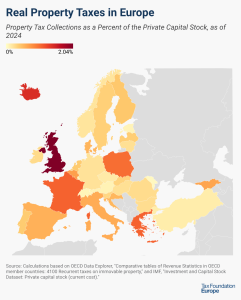
Real Property Taxes in Europe, 2026
High property taxes levied not only on land but also on buildings and structures can discourage investment in infrastructure, which businesses would have to pay additional tax on.
3 min read
2026 Spanish Regional Tax Competitiveness Index
The 2026 Spanish Regional Tax Competitiveness Index allows policymakers and taxpayers to evaluate and measure how their regions’ tax systems compare.
8 min read
Tobacco Excise Directive: Trade-Offs for the Harmonization Vision
The European Union’s revised Tobacco Excise Directive (TED) is the latest proposal from Brussels that raises questions about the role that the EU plays in relation to the Member States.
7 min read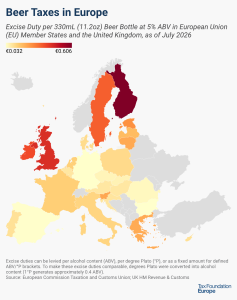
Beer Taxes in Europe, 2026
With much of the continent celebrating Oktoberfest, it is a great time to examine beer taxes across Europe. Hefty beer taxes increase the price consumers pay for their libations.
5 min read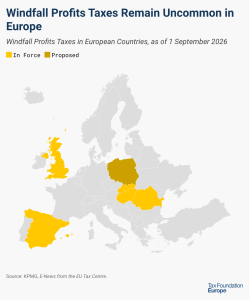
Windfall Profits Taxes in Europe, 2026
As energy prices have declined, European countries have switched the focus of their windfall profits taxes—a one-time tax levied on a company or industry when economic conditions result in large, unexpected profits—from energy providers to the banking and financial sector.
7 min read
Testimony: Legislative Proposal to Adapt the Income Tax Code to the Digital Economy Repeats the Economic and Legal Mistakes of Digital Services Taxes
The Belgian proposal departs significantly from sound tax policy principles and risks generating substantial economic distortions, legal uncertainty, and trade frictions while raising relatively little revenue.
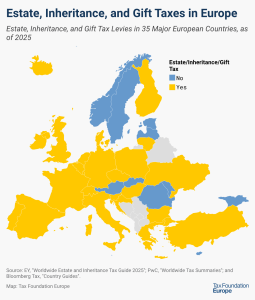
Estate, Inheritance, and Gift Taxes in Europe, 2026
Twenty-four out of the 35 European countries covered in this map currently levy estate, inheritance, or gift taxes.
4 min read
How Poland’s Restrictive Tax Treatment of Losses Penalizes Risk-Taking and Business Expansion
Poland has one of the most restrictive approaches to the tax treatment of losses in the OECD. Loss carryover provisions allow businesses to deduct their losses in one year against taxable income in another, smoothing their taxable income over time. Their absence or restriction leads to firms with more variable profits and losses over time being taxed at higher rates, penalizing risky investment, such as research and development (R&D), and business expansion.
16 min read
How Tax Cliffs Hold Back Poland’s Individual Business Owners
Poland taxes its individual business owners through alternative regimes and a series of thresholds, several of them sharp notches that imply significant tax costs for businesses crossing them.
11 min read