State Tax Changes Taking Effect July 1, 2024
Summer has arrived and states are beginning to implement policy changes that were enacted during the legislative session (or are being phased in over time).
13 min read

Manish Bhatt was the former Vice President of State Tax Policy at the Tax Foundation, where he oversaw the Center for State Tax Policy and the strategic vision for the team. In addition, Manish advised state lawmakers and stakeholders on the principles of sound tax policy.
He routinely speaks around the country about state and local tax policy, including testifying before state legislatures. In 2024, his recommendations were pivotal to securing Louisiana’s broad tax reform, and he was appointed to Montana’s Property Tax Task Force. His work has been cited by the Financial Times, Forbes, CNBC, Newsweek, USA Today, and many state media outlets.
Prior to joining the Tax Foundation, Manish counseled clients on foreign currency transactions, international corporate taxation, transfer pricing, and tax accounting at a Big Four accounting firm. Additionally, he has advised several startups and taught business law as an adjunct faculty member at TCU. Manish is a veteran of the US Coast Guard, serving as an officer and Judge Advocate.
He holds an LLM in taxation from Georgetown University Law Center, a JD from St. Thomas University College of Law, and a BA from the George Washington University. In his free time, Manish enjoys fly fishing, equestrian sports, and skiing with his family.

Summer has arrived and states are beginning to implement policy changes that were enacted during the legislative session (or are being phased in over time).
13 min read
With proposals to adopt the nation’s highest corporate income tax, second-highest individual income tax, and most aggressive treatment of foreign earnings, as well as to implement an unusually high tax on property transfers, Vermont lawmakers have no shortage of options for raising taxes dramatically.
7 min read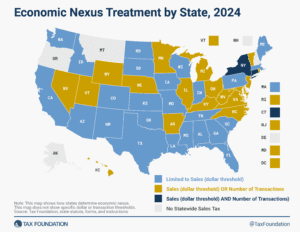
Reforming economic nexus thresholds would not only be better for businesses but for states as well. It is more cost-effective for states to focus on—and simplify—compliance for a reasonable number of sellers than to impose rules that have low compliance and are costly to administer.
4 min read

Vermont lawmakers are considering the adoption of two new taxes on high earners, which proponents have branded “wealth taxes.”
4 min read
Nebraskans need property tax relief and there are sound ways to provide it. However, increasing the sales tax rate to the highest in the country and dramatically increasing cigarette excises is not sound tax policy.
5 min read
Thirty-four states will ring in the new year with notable tax changes, including 15 states cutting individual or corporate income taxes (and some cutting both).
17 min read
The current patchwork of state laws taxing marketplace facilitators is complex, burdensome, and inefficient. States should work to resolve these issues and standardize the otherwise disparate requirements—with or without an inducement from Congress or the courts.
29 min read
Policymakers at all levels of government should avoid the pitfalls of incentives. Instead, they should focus on creating a more efficient, neutral, and structurally sound tax code to the benefit of all types of business investment.
6 min read
Recharacterizing a rather simple repayment transaction as a tax rebate is concerning, not just for sound tax policy, but also for the future of public-private financing partnerships.
4 min read
Montana Policymakers should pursue principled property tax reform that benefits all property owners without creating market distortions or unfairly shifting the tax burden.
5 min read
However well-intended they may be, sales tax holidays remain the same as they always have been—ineffective and inefficient.
4 min read
Texas’s robust surpluses create an opportunity to use state funds to lower local property taxes. However, it remains important for legislators to pursue a principled approach to rate compression, rather than enacting a plan that will simply shift the tax burden in nonneutral ways.
3 min read
In the closing days of the 2023 legislative session, Oklahoma lawmakers repealed the state’s corporate franchise tax and eliminated the marriage penalty in its individual income tax. Both tax changes represent a positive step forward for the state.
4 min read
Legislation currently advancing in Louisiana—related to the franchise tax, inventory tax, and corporate rebate and exemption programs—would make the state’s tax code simpler and more competitive.
4 min read
Michiganders will pay a lower individual income tax rate next year thanks to high general fund revenues, but these savings may be short-lived following an opinion released by the state’s attorney general.
7 min read