
Skip to content
Abir Mandal Tax Foundation
Expert

Abir Mandal

Senior Policy Analyst

Abir Mandal is a Senior Policy Analyst with the Tax Foundation’s Center for State Tax Policy, where he conducts research on state tax competitiveness, business taxation, and property tax structure. He co-authors the State Tax Competitiveness Index, the Tax Foundation’s flagship annual study ranking the tax systems of all 50 states. His empirical research analyzes how state tax structures shape interstate migration of households and capital, as well as local government finance.

Mandal’s peer-reviewed academic work has appeared in The Journal of Private Enterprise, the Journal of Economics and Finance, and the Journal of Applied Business and Economics. His research on property tax reform—including the case for levy limits over assessment caps—has been cited in legislative deliberations in Iowa, Hawaii, and Rhode Island, and he has provided expert testimony before the North Carolina General Assembly. He has authored analysis in Tax Notes and MarketWatch, and his research and commentary have been cited by academics, practitioners, and journalists in outlets including The New York Times, the New York Post, and Bloomberg Tax. He is a frequent commentator on state tax policy in national media and has presented his findings at tax policy conferences across the country. He resides in Raleigh, NC.

Latest Work

State and Local Sales Tax Rates, Midyear 2026

State and Local Sales Tax Rates, Midyear 2026

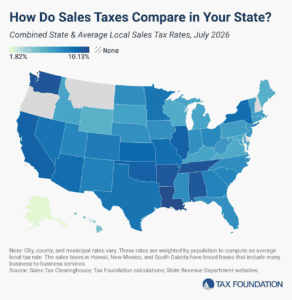
The five states with the highest average combined state and local sales tax rates are Louisiana (10.13 percent), Tennessee (9.61 percent), Washington (9.57 percent), Arkansas (9.48 percent), and Alabama (9.46 percent).

8 min read
High-Tax States Competitiveness, Wealth Taxes

Targeting High Earners is Misguided and Will Worsen States’ Fiscal Positions

Policies that increase the tax burden on high earners makes states less competitive, increase revenue volatility, discourage investment, and risk accelerating outmigration of talent and capital. Many top-earners are already leaving high-tax states for Florida, North Carolina, and other low-tax jurisdictions.

9 min read

Avenues for Property Tax Reform in North Carolina

When evaluating property tax reform options in North Carolina, only changes that restore balance—without distorting investment or shifting costs unfairly—will ensure the state’s local tax system supports, rather than hinders, continued prosperity.

8 min read
North Carolina Does Not Need Higher Local Taxes

North Carolina Does Not Need Higher Local Taxes

As a result of state-level reforms, the expansion of the sales tax base, and rising property valuations, North Carolina’s local governments have seen remarkable revenue growth in recent years.

13 min read
2026 state and local sales tax rates by state

State and Local Sales Tax Rates, 2026

Retail sales taxes are an essential part of most states’ revenue toolkits, responsible for nearly a quarter of combined state and local tax collections.

18 min read
2026 state corporate income tax rates and brackets by state

State Corporate Income Tax Rates and Brackets, 2026

Forty-four states levy a corporate income tax, with top rates ranging from a 2 percent flat rate in North Carolina to an 11.5 percent top marginal rate in New Jersey. Four states—Georgia, Nebraska, North Carolina, and Pennsylvania—reduced their corporate income tax rates effective January 1, 2026.

5 min read
Washington DC council decoupling tax code OBBBA

DC Should Be Judicious About Decoupling from the OBBBA

While the Council of DC is right to consider decoupling its tax code from several revenue-reducing provisions in the OBBBA, they should maintain conformity with the business expensing reforms that are strongly pro-growth, better align with sound tax principles, and primarily change the timing of revenues.

4 min read
2026 State Tax Competitiveness Index 2026 State Tax Rankings

2026 State Tax Competitiveness Index

The State Tax Competitiveness Index enables policymakers, taxpayers, and business leaders to gauge how their states’ tax systems compare. While there are many ways to show how much state governments collect in taxes, the Index evaluates how well states structure their tax systems and provides a road map for improvement.

122 min read

North Carolina Should Refine Its Tax Reduction Triggers

By implementing a more sophisticated and nuanced trigger system for its tax reduction goals, North Carolina can sustain its trajectory toward lower tax rates, reinforce its reputation as a business-friendly state, and ensure long-term fiscal stability in an ever-changing economic landscape.

4 min read