America Celebrates Tax Freedom DayŽ

America Will Work One Day More for Government in 2010 than in 2009; Recession and Tax Cuts Have Made Tax Freedom Earlier

Tax Freedom Day will arrive on April 9 this year, the 99th day of 2010, according to our annual calculation using the latest government data on income and taxes. Americans will work well over three months of the year—from January 1 to April 9—before they have earned enough money to pay this year's tax obligations at the federal, state and local levels.

This year's Tax Freedom Day is one day later than in 2009, but more than two weeks earlier than in 2007. The shift toward a lower tax burden since 2007 has been driven by three factors: (1) The recession has reduced tax collections even faster than it has reduced income; (2) President Obama and the Congress have enacted large but temporary income tax cuts for 2009 and 2010, just as President Bush did in 2008; and (3) Two significant taxes were repealed for 2010 as part of previous legislation, the estate tax and the so-called PEP and Pease provisions of the income tax.

Despite all these tax reductions, Americans will pay more taxes in 2010 than they will spend on food, clothing and shelter combined.

Taxes and the Federal Deficit

Tax Freedom Day does not count the deficit even though deficits must eventually be financed. Since 1948, when Tax Freedom Day was first calculated, the difference between what governments are spending and what they're collecting has never been as great as during 2009 and 2010. If Americans were required to pay for all government spending this year, including the $1.3 trillion federal budget deficit, they would be working until May 17 before they had earned enough to pay their taxes—an additional 38 days of work.

This May 17 date for a deficit-inclusive measure is the second latest since World War II. Only in 2009 was it later, when an unprecedented budget deficit of close to $1.5 trillion produced a deficit-inclusive date of May 21, fully 43 days later than Tax Freedom Day.

Tax Freedom Day in Recent Years

In 2000, Tax Freedom Day was celebrated May 1, the latest date ever. A string of tax cuts between 2001 and 2003 pushed Tax Freedom Day up by two weeks, so that it fell on April 14 in 2003 - at the time the second earliest Tax Freedom Day since the Johnson administration.

From 2003 through 2006, corporate income taxes rose rapidly along with rapidly growing corporate profits. Personal income tax receipts also rose sharply, starting in 2004. As a result, Tax Freedom Day was delayed, reaching April 24 in 2006.

Since 2007, stimulus tax cuts and a weakening economy have come together to push Tax Freedom Day earlier. Meanwhile, government spending has continued to grow (especially rapidly in 2009) resulting in the first ever 10-figure federal budget deficit.

Which Taxes Are the Biggest?

Five major categories of taxes dominate the tax burden. Individual income taxes—including federal, state and local—require 32 days' work. Payroll taxes take another 25 days' work. Sales and excise taxes, mostly state and local, take 15 days to pay off. Corporate income taxes take 8 days, and property taxes take 12. Americans will log 6 more days to pay other miscellaneous taxes, most notably including motor vehicle license taxes and severance taxes, and about half a day for estate taxes.

Tax Freedom Day by State

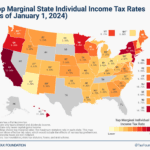
Each state has its own Tax Freedom Day. Because of modest incomes and low state and local tax burdens, Alaska and Louisiana celebrate Tax Freedom Day earliest on March 26, the 85th day of the year. Connecticut celebrates last on April 27, the 117th day of the year, because income per capita is higher than in any other state. High-income states pay much more in federal taxes, and they often have higher state-local taxes as well. Joining Connecticut in the latest celebrations are New Jersey (April 25), New York (April 23), Maryland (April 19) and Washington (April 15). Alaska and Louisiana are joined in early celebration by Mississippi (March 28), South Dakota (March 29) and West Virginia (March 30).

Tax Freedom Day by State, 2010
State Days Spent Working to Pay Taxes  Tax Freedom Day Rank
United States 99 April 9 -
Alabama 92 April 2 42
Alaska 85 March 26 50
Arizona 94 April 4 37
Arkansas 93 April 3 38
California 104 April 14 7
Colorado 100 April 10 17
Connecticut 117 April 27 1
Delaware 100 April 10 18
Florida 95 April 5 31
Georgia 98 April 8 24
Hawaii 99 April 9 19
Idaho 98 April 8 22
Illinois 101 April 11 14
Indiana 96 April 6 29
Iowa 94 April 4 36
Kansas 97 April 7 25
Kentucky 93 April 3 41
Louisiana 85 March 26 49
Maine 94 April 4 34
Maryland 109 April 19 4
Massachusetts 104 April 14 6
Michigan 98 April 8 21
Minnesota 103 April 13 8
Mississippi 87 March 28 48
Missouri 94 April 4 35
Montana 95 April 5 33
Nebraska 97 April 7 27
Nevada 92 April 2 43
New Hampshire 96 April 6 28
New Jersey 115 April 25 2
New Mexico 91 April 1 45
New York 113 April 23 3
North Carolina 97 April 7 26
North Dakota 93 April 3 39
Ohio 98 April 8 23
Oklahoma 96 April 6 30
Oregon 98 April 8 20
Pennsylvania  103 April 13 11
Rhode Island 102 April 12 12
South Carolina 93 April 3 40
South Dakota 88 March 29 47
Tennessee 91 April 1 44
Texas 95 April 5 32
Utah 101 April 11 15
Vermont 103 April 13 9
Virginia 103 April 13 10
Washington  105 April 15 5
West Virginia 89 March 30 46
Wisconsin 102 April 12 13
Wyoming 101 April 11 16
District of Columbia  105 April 15

How Tax Freedom Day Is Calculated

Tax Freedom Day answers the basic question, "What price is the nation paying for government?" An official government figure for total tax collections is divided by the nation's total income. The answer this year is that taxes will amount to 26.89 percent of our income, and the stretch of 99 days from January 1 to April 9 is 26.89 percent of the year. Income and tax data are then parsed out to the states, yielding 50 state-specific Tax Freedom Days.

Read the Tax Freedom Day Special Report.